
Build. Innovate. Prototype. Change the World.
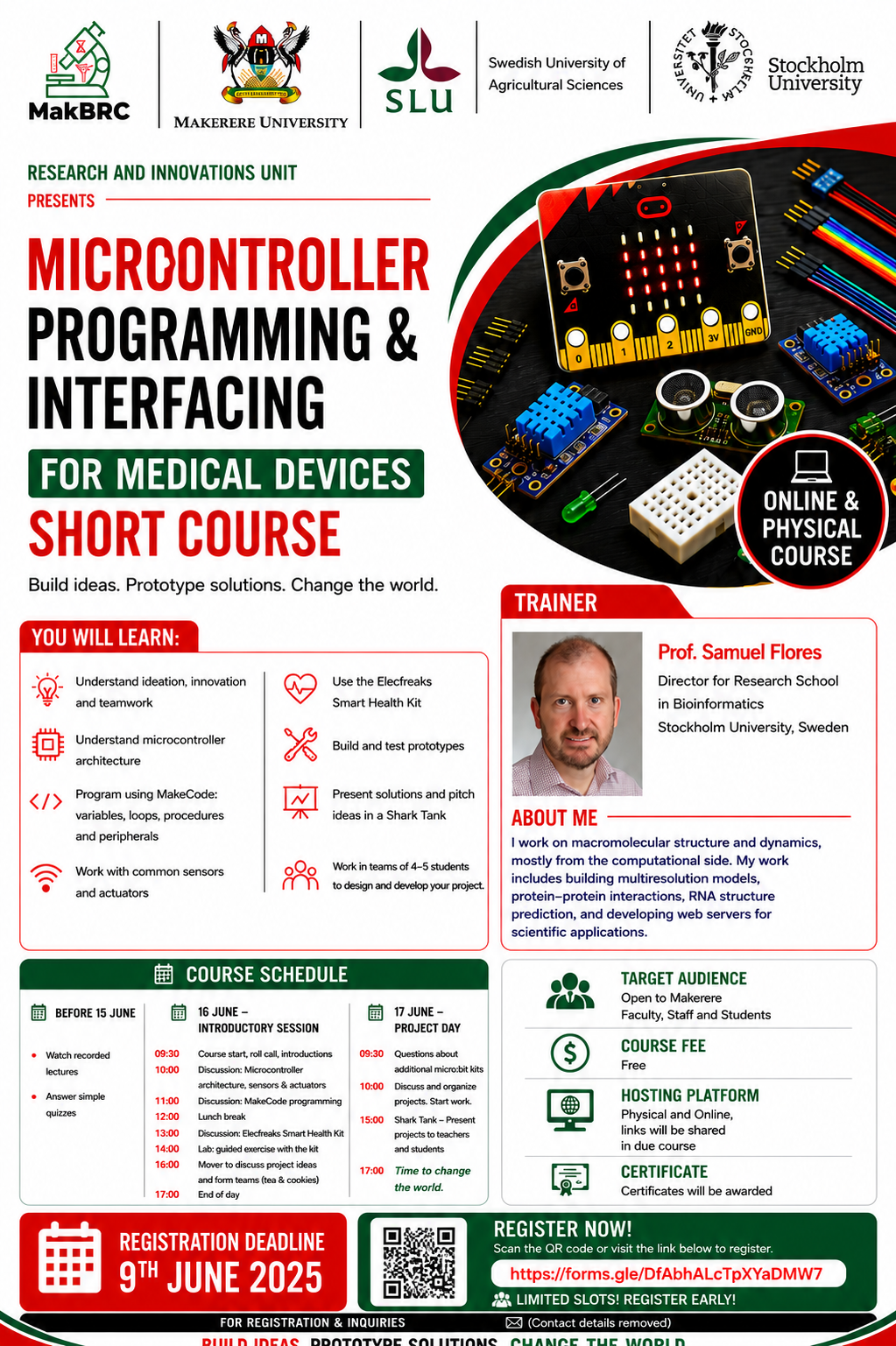
The Research and Innovations Unit invites students, innovators, makers, and aspiring tech entrepreneurs to participate in an exciting Online Microcontroller Programming and Interfacing Course designed to introduce participants to embedded systems, innovation, and product prototyping using the micro and the Elecfreaks Smart Health Kit.
This hands-on course combines creativity, teamwork, programming, and electronics to help participants transform ideas into real-world prototypes.
COURSE HIGHLIGHTS
Participants will learn how to:
- Understand the process of ideation and innovation
- Explore innovation cultures and teamwork approaches
- Understand basic microcontroller architecture
- Program using Microsoft MakeCode
- Work with variables, loops, procedures, and peripherals
- Interface with sensors and actuators
- Evaluate and select components for real-world applications
- Use the Elecfreaks Smart Health Kit
- Build and test simple prototypes
- Present innovative project ideas in teams
The course follows the flipped spaced-repetition learning model developed in Sweden, combining recorded lectures, interactive discussions, guided labs, quizzes, and collaborative projects.
COURSE SCHEDULE
Before 9th June
- Watch recorded lectures
- Complete introductory quizzes
16 June – Introductory Session
9:30 AM – Course start, roll call, introductions
10:00 AM – Discussion: Microcontroller architecture, sensors & actuators
11:00 AM – Discussion: MakeCode programming
12:00 PM – Lunch break
1:00 PM – Discussion: Elecfreaks Smart Health Kit
2:00 PM – Guided lab exercise
4:00 PM – Innovation mixer, project discussions & team formation
5:00 PM – End of day
Evening Activities
- Lab quizzes
- Videos on additional micro kits
- Additional kit quizzes
17 June – Project Day
9:30 AM – Questions about additional kits
10:00 AM – Team project development
3:00 PM – Shark Tank project presentations
5:00 PM – “Time to change the world”
TRAINER
The course will be facilitated by an experienced international trainer from Stockholm University.
Trainer Profile:
https://www.su.se/english/profiles/s/sflor
WHO SHOULD APPLY?
This course is ideal for:
- Students interested in electronics and programming
- Innovators and makers
- Beginners in embedded systems
- Aspiring startup founders
- Anyone interested in building smart solutions using technology
COURSE FORMAT
- Online delivery
- Team-based practical learning
- Interactive labs and innovation activities
- Guided prototype development
LIMITED SLOTS AVAILABLE
Participants will work in teams of 4–5 students. Early registration is encouraged.
For registration and inquiries, please contact the Research and Innovations Unit.
Innovate. Prototype. Build the future.
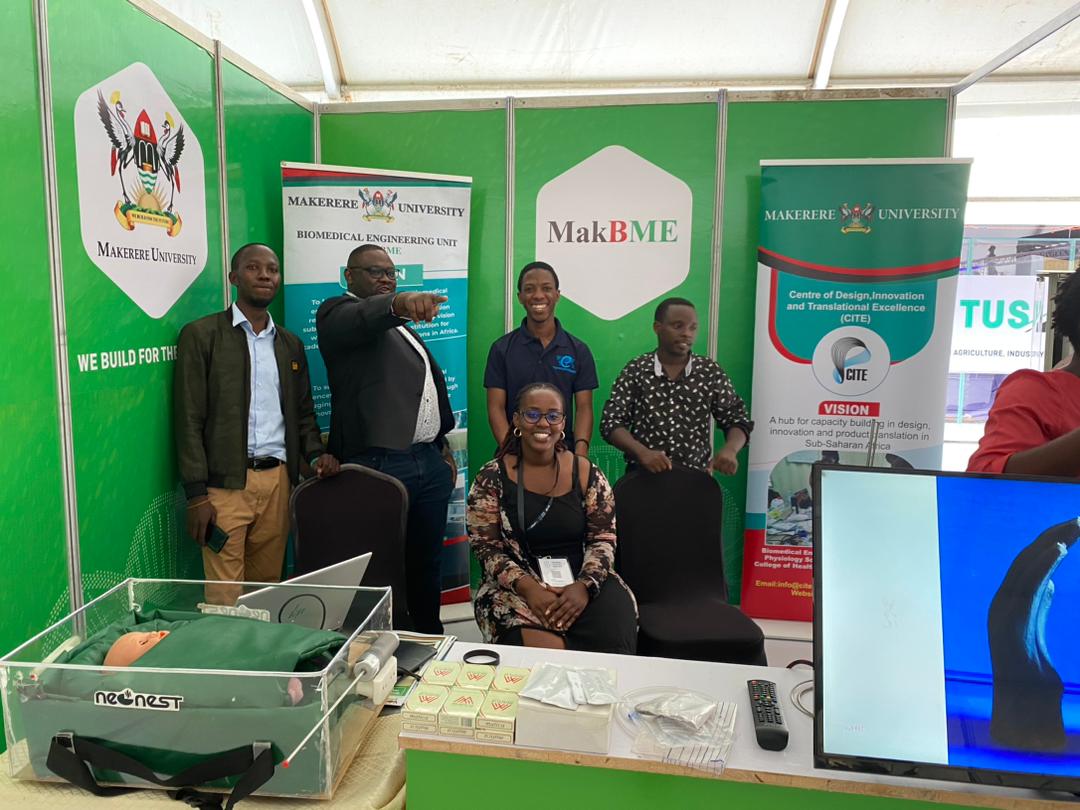
 Description of Technology: KeySuite is a laparoscopic system designed for low- and middle-income countries (LMICs). It was developed through the human-centered-design process, by a multi-disciplinary collaboration of surgeons, engineers, global health scientists, attorneys and business experts at Duke University, Makerere University and University of Maryland. Our laparoscope (KeyScope) can be built for $600 (cost of goods) and does not require a constant supply of electricity or carbon dioxide. Rather than using fiber optic cables, it contains light emitting diodes (LEDs) and a color complementary metal-oxide-semiconductor (CMOS) detector, enabling a significant decrease in cost and complexity. Images can be displayed on a laptop computer, obviating the need for expensive monitors and preventing loss of function during power-outages. It is a single-unit device, and therefore lost parts will not inhibit continued use. The unit can be sterilized by immersion in Cidex. We have developed a laparoscopic retractor, KeyLoop, to mechanically lift the abdominal wall, eliminating the need for carbon dioxide supply and continuous pressure regulation. KeyScope and KeyLoop were intentionally designed to be manufactured in Uganda.